
The first real cold front of the season came through the weekend of November 13. In the Juno Bait weekly fishing outlook, Todd wrote that the strong north winds "should fire the sailfish up." He pointed boats to the usual starting point of 150 to 250 feet of water between the Juno Beach Pier and Jupiter Inlet, with live goggle eyes and blue runners under the kite. A week later the same report described the sailfish bite as fair, with most of the fish still to the north and the weekend offshore forecast largely blown out. That is how most Jupiter winters start, with a few good days between fronts and the run building as the cold air keeps coming.
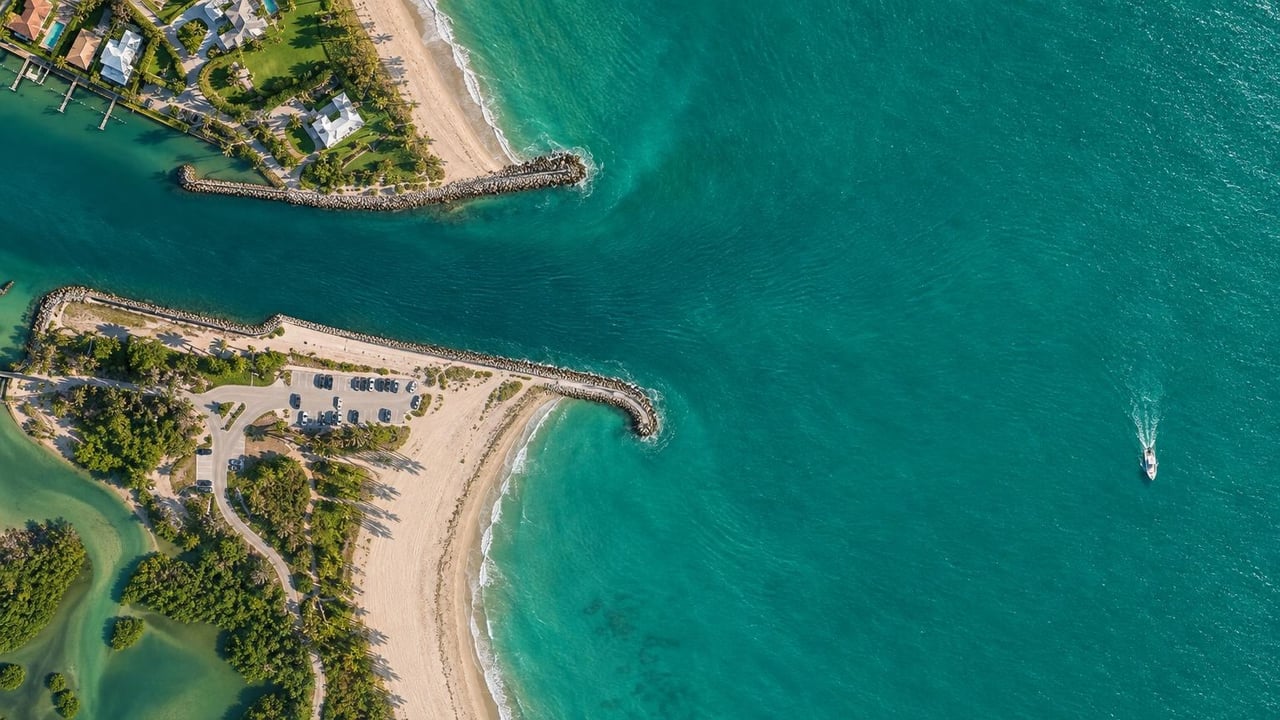
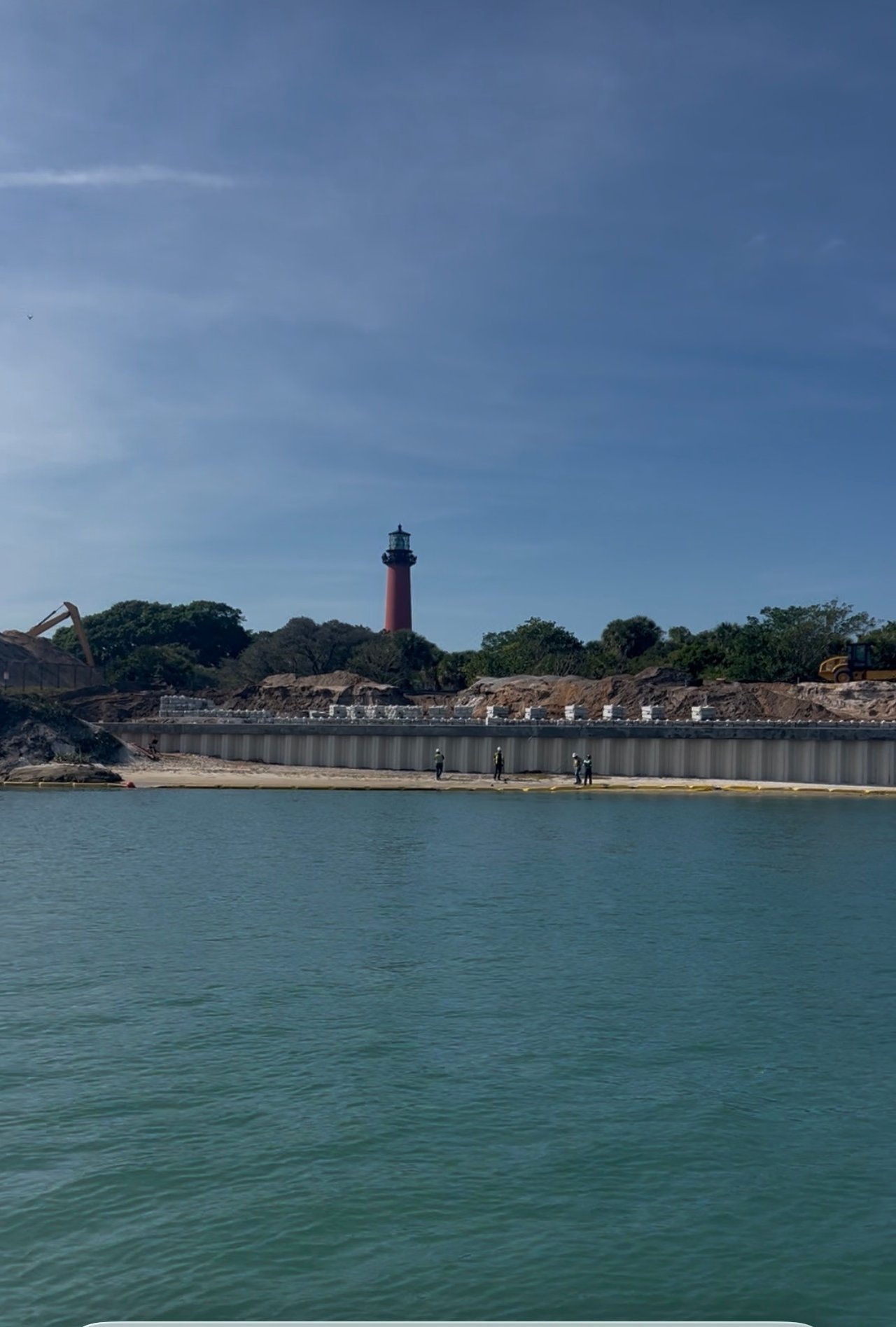
For anyone who keeps a boat on the Loxahatchee or the Intracoastal, a run to that sailfish water starts at the inlet mouth. This winter there will be a dredge working in Jupiter Inlet again, but it will be pumping sand from the trap inside the inlet. The sandbar outside the mouth, the one local captains drew attention to last spring, is a separate project, and it is still being studied.
Jupiter Inlet has two sand problems. The sand trap sits inside the inlet and catches sand before it moves farther in. The Jupiter Inlet District dredges it on a regular cycle and pumps the material onto the beach south of the inlet. Outside the mouth is the ebb shoal, the bar of sand that tidal currents push seaward, and boats leaving the inlet have to cross it.
The District's 2026 project removed about 176,000 cubic yards from the sand trap and was finished on April 26, 2026. As WPTV reported, that work ran in two phases, January 17 to February 15 and April 14 to April 26. It reached only the sand trap inside the inlet. The sandbar conditions boaters were reporting sat outside the inlet mouth. The District told WPTV it had begun taking steps toward a longer-term solution there.
That WPTV story ran on April 28. It followed a video by Capt. Tyler Baruch, a Jupiter native who has fished professionally for 15 years, which had been viewed more than 400,000 times. He asked elected officials to act on the outer bar. He told WPTV he wanted "consistent dredge pumping, just like we have in West Palm and other inlets."
On the day the story aired, the District was on a call with the U.S. Army Corps of Engineers, and Congressman Brian Mast and Col. Brandon Bowman of the Corps both spoke to WPTV about the inlet. The District described a channel through the bar as a major undertaking that would take a significant budget increase. Seven months later, the District's own meeting packets show where that work stands.
As of the District's November 2026 meeting packet, the work on the ebb shoal is engineering. Taylor Engineering, the District's consultant, is running what its report calls "expedited analyses" of what dredging a navigation channel through the ebb shoal would do. The analyses cover two questions: salinity in the Loxahatchee River and the effect on nearby beaches.
The salinity question matters most to people who live on the river. Taylor has finished analyzing salinity, discharge and rainfall data from periods when natural outlet channels existed. It has also completed estimates of saline wedge lengths, and the firm is now drafting a report of its findings. A channel through the bar at the mouth is being studied for what it would mean upstream in the Loxahatchee.
The beach question uses modeling. Taylor modeled hydrodynamics, waves, sediment transport and morphology over a representative one-month period, once without an ebb-shoal channel as a baseline and once with one. Those results will update the longshore sediment budget, which tracks how sand moves along the coast, to estimate the channel's long-term effect on adjacent beaches.
Both studies are still in progress. At the October 14 Board meeting, the "Jupiter Inlet Ebb Shoal and Navigation Discussion" was listed under unfinished business, and the minutes record "No updates" under that item. For anyone planning a winter of offshore runs, a fix for the outer bar will not arrive this sailfish season.
The sand-trap project is moving on a firm schedule. At the same October 14 meeting, the Board unanimously approved Taylor Engineering's proposal for design, bid support, construction and administration of the 2027 sand-trap project. The approval was on a time-and-materials basis, not to exceed $56,129.
The District advertised the construction contract on November 6, 2026. The job calls for dredging about 100,000 cubic yards from the sand trap inside Jupiter Inlet with a hydraulic cutter suction dredge and pumping it to the beach south of the inlet. The contractor must finish by April 30, 2027. That is a smaller job than the roughly 176,000 cubic yards taken out in the 2026 project.
Bids open at 1 p.m. on Monday, December 7, at the District office at 400 North Delaware Boulevard. The consultant plans to bring an award recommendation to the Board's December meeting. The District calendar lists that meeting for December 9. The engineering scope assumes about 40 calendar days of construction, sometime between December 2026 and April 2027. The District schedules its inlet projects around sea turtle nesting season, and it finished the 2026 work inside the permitted nesting construction window.
The money comes partly from the state. Grant agreement 27PB1 provides $1,450,000 in state funding toward the fees for the spring 2026 sand-trap project, and Taylor Engineering is still compiling deliverables for it.
The dredge's season falls during the busiest stretch of the sailfish calendar. The Pirate's Cove Sailfish Classic fishes out of Pirate's Cove Resort & Marina in Stuart, December 9 to 12. The West Palm Beach Fishing Club's Silver Sailfish Derby fishes January 7 and 8, with a 50-boat cap. Operation Sailfish is headquartered at Sailfish Marina Resort in Palm Beach Shores, with competition on January 15 and 16. The Sailfish Club of Florida's invitational Gold Cup runs January 26 to 30. None of those events is based in Jupiter, but they mark the weeks when the season peaks along this stretch of coast. For a Jupiter boat, that peak falls during the dredge's working window.
The District publishes its surveys. Its latest ebb-shoal chart is labeled October 2026, with a survey date of October 5 and a drawing date of October 6. The District's bathymetric surveys page states that its maps show conditions only at the time of each survey and that those conditions can change. A month and a half of fall swell has passed since October 5, including blown-out weekends with seas building to 9 feet in the November 20 to 22 forecast that Juno Bait quoted from NOAA. The October chart is a starting point for reading the bar, not a current depth.
The District's navigational aids page describes quarterly inspections of the markers it maintains. It also explains how to report a marker that is missing or down. After a stretch of hard northeast wind, it is worth knowing where that page is.
The next dates on the District's calendar are close. Bids for the sand-trap job open December 7, and the Board meets December 9, when the award recommendation is expected. Agendas and packets for each meeting, including the engineer's report on the ebb-shoal studies, are posted on the District's commission meetings page.
The inlet is one of the main reasons people live on the water here, as we have written in our look at waterfront living in Jupiter. For the inside of the inlet, our earlier post on the Jupiter Lighthouse boardwalk and its anchorage covers the other big change on this water.
If the run out Jupiter Inlet figures into how you choose between a riverfront, Intracoastal or oceanside home, Malloy Home Team can talk through how inlet access and the timing of these dredge projects fit with the property you have in mind. When you are ready, Schedule a Consultation.
In a market where presentation, strategy, and relationships define outcomes, choosing the right team isn’t optional, it’s everything. At the Malloy Home Team at SERHANT., we don’t just list homes. We position them. We don’t just find properties. We secure opportunities others never see.

114 N Coastal Way Jupiter, FL 33477